
What do you keep from a box of old family photographs?
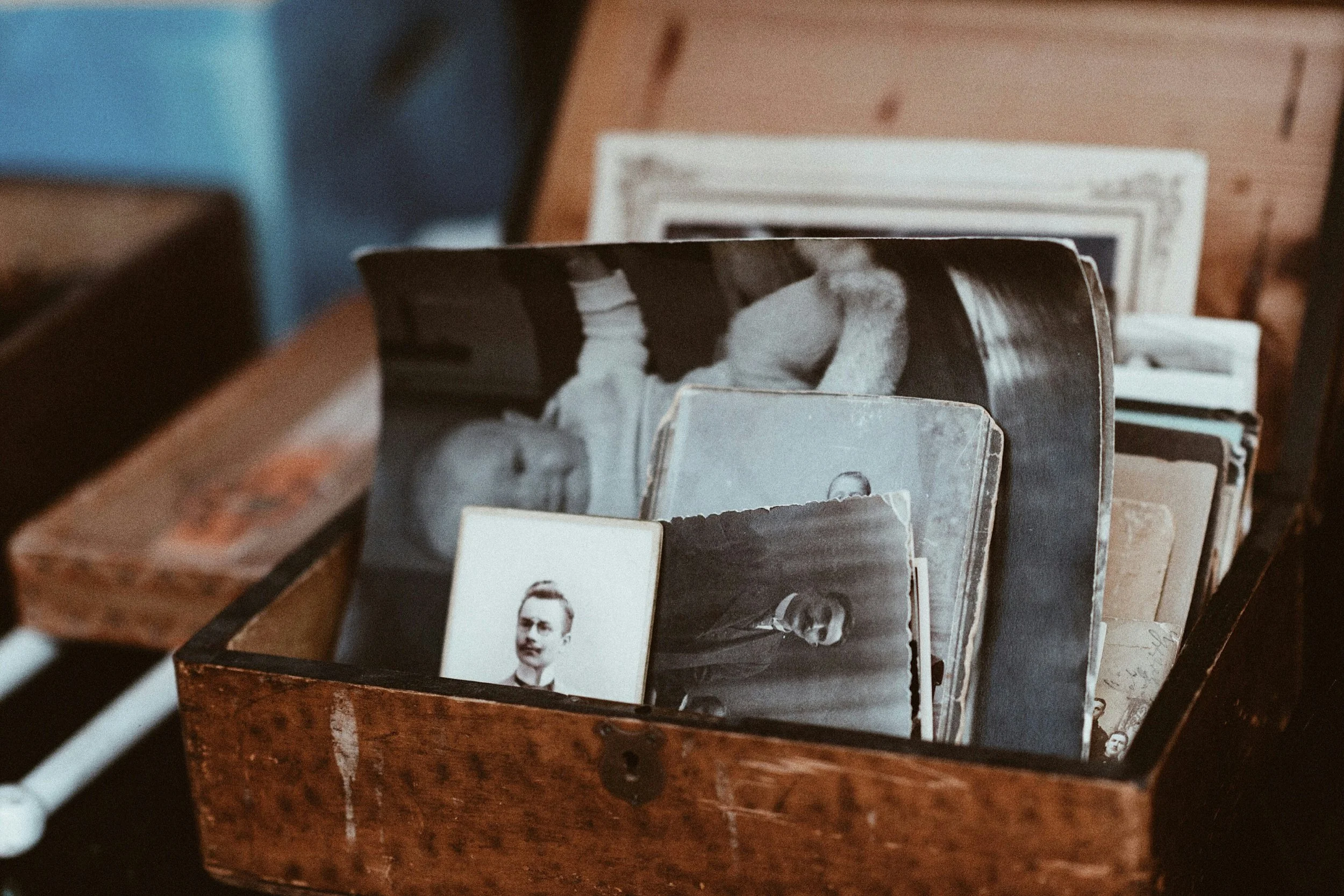
A box full of old family photographs, and no idea where to begin? In ten gentle steps, bring some order to the collection, decide what to keep, and preserve the stories that might otherwise be lost.
Photo by Roman Kraft on Unsplash
You have found a box, envelope or stack of old photographs in the attic or tucked away in a cupboard.
Perhaps they are neatly arranged in one or more albums, with details written in handwriting you would recognise anywhere: where the photograph was taken, who is in it, a date, and perhaps even something about why that particular moment was worth keeping.
Or, as is so often the case, perhaps they are in complete disarray. Photographs are scattered between cupboards, drawers, albums and boxes. The context has disappeared, the stories behind them are in danger of disappearing too, and the task feels so overwhelming that you simply don't begin.
It may make you think of the thousands of photographs sitting on your phone. I'll come to those in another article. This one is about the physical prints we have inherited, or accumulated ourselves over the years.
So where do you begin?
And how do you bring some order to them without losing the stories and small pieces of family history they hold?
These ten steps will help you start.
Start small
Choose one box, one envelope or one small stack.
That's all.
You don't need to tackle the entire collection at once. Trying to do so can quickly become overwhelming, making it much more likely that you'll give up before you've really begun.
Look first
Let the photographs pass through your hands. Look at who and what is in them.
You don't need to decide, discard or categorise anything yet.
For now, you are simply getting a sense of what you have in front of you.
Set aside what you know you want to keep
Which photographs immediately draw you in?
Perhaps they show people who matter to you, a place you recognise, an important occasion or a wonderfully ordinary moment. Perhaps there is something written on the back in handwriting you would know anywhere.
Set aside the photographs you already know you want to keep.
These are your keepers.
Begin with the easy decisions
If you have several copies of the same photograph, or a series of almost identical images, choose the best one to keep.
A damaged, blurred or technically imperfect photograph doesn't automatically need to go. It may still show something that exists nowhere else. Even the once surprisingly common finger over the lens might belong to a photograph worth keeping.
But if you find, for example, a photograph of a waterfall and nobody knows where it was taken, who took it or why it mattered, and the image means nothing to you, perhaps you don't need to keep it.
If you have duplicates that do matter, consider passing an extra copy to another family member or to someone who appears in the photograph.
Begin with the easy decisions.
The difficult ones can wait.
Before you discard anything
Check envelopes, photograph wallets and boxes for negatives and slides. They are easy to overlook, particularly when the corresponding prints are already in the collection. Don't automatically discard a negative or slide simply because you have found a print. There may be images on a roll or strip that were never printed, and the negative may provide a better source for making a new scan.
Make a ‘not sure’ pile
Not sure? Make a separate pile for the photographs you aren't yet ready to keep or let go.
It is fine to be uncertain. You don't have to make every decision today, and you don't have to make every decision alone.
Protect fragile or irreplaceable photographs
Avoid writing directly on fragile or irreplaceable original photographs. Instead, record information on a separate piece of acid-free, lignin-free paper and keep it with the photograph, or use suitable archival materials to keep the photograph and its information together.
For particularly fragile or important photographs, consider an acid-free envelope, folder or archival sleeve. Avoid sticky notes, adhesive tape, rubber bands and self-adhesive labels on or directly against the original, as these can leave marks or cause damage over time.
See what you already know
Return to the photographs you have chosen to keep. Who do you recognise? Which places? Which events? Do you know approximately when a photograph was taken, even if all you have is a decade or a rough year? Begin with four simple questions:
Who?
What?
Where?
When?
There is no need to research anything yet. First, establish what you already know.
Ask for the stories, while you still can
Take photographs from your keep and ‘not sure’ piles to a relative or family friend who might know more. And don't only ask for names and dates.
Who is this?
Where were you?
What was happening here?
Why was this photograph taken?
What do you remember about this person or place?
One photograph can be a much easier way to begin a conversation than asking someone, ‘Tell me about your life.’ Sometimes an apparently unremarkable photograph leads to a story you didn't even know existed.
Record the story behind the photograph
Names, relationships, places and dates matter, but don't stop there. Record what someone looking at the photograph in the future couldn't possibly know from the image alone.
Why did this moment matter? What happened just before or afterwards? Why was this photograph kept? What do you know about the person in it? What do you remember when you look at it? You don't have to do this for every photograph. Pay particular attention to the information that would disappear if nobody wrote it down.
Decide what needs to remain physically
Not every photograph needs to stay. Keep important originals carefully. For fragile or irreplaceable photographs, consider making a good digital copy as well, so the image isn't dependent on one physical print surviving.
For some photographs, you may decide that a digital copy is enough. Duplicates can be passed on. And sometimes you may realise that what you most want to preserve is the story a photograph prompted rather than every physical copy of the image. Look again at any negatives and slides you found. Which belong to important images? Are there photographs among them for which no print exists? Which are worth preserving or having professionally digitised?
The aim isn't to get rid of as much as possible. It is to choose deliberately what you want to keep, and in what form.
Bring what you have chosen together
Give the photographs you have chosen a home. That might be an album, archival box, folder or a collection of envelopes. You could group them by person, family, place, period or event. Choose an arrangement that makes sense to you and that someone else could reasonably understand later.
The important thing isn't to create a perfect archival system. It is to make sure that the photographs you choose can still tell some of their story when you are no longer standing beside them to explain.
It isn't about how much you keep
There is no correct number of family photographs to preserve.
A large collection without names, dates or stories can eventually become almost impossible for another person to understand. A much smaller collection, carefully chosen and given context, can carry an extraordinary amount of a family's history.
So the next time you open that drawer, album or box, don't ask yourself to sort everything.
Choose one photograph. Turn it over, and ask:
What do I know about this that someone else might not?
Write that down.
That's already a beginning.
Would you like to go a little further?
Perhaps it doesn't end with photographs. There may also be letters, cards, recipes, documents or small objects that carry a story. Things you want to keep, but whose significance someone else might not automatically understand.
The Tender Archive is a gentle printable guide to help you bring those pieces together, decide what you want to preserve and record the information and stories that might otherwise be lost.
You don't have to do everything.
Just as with that one photograph, you can begin with one small thing.